A unified feed-forward model for geometry perception. The project page shows reconstructions from campus scenes to driving sequences, results across seven tasks, and an available live demo.
An inference-time rule for action-chunking robot policies: continue a chunk while predicted futures agree and replan when they diverge. The paper reports reductions in failures in its simulation benchmarks and AgiBot G2 manipulation experiments.
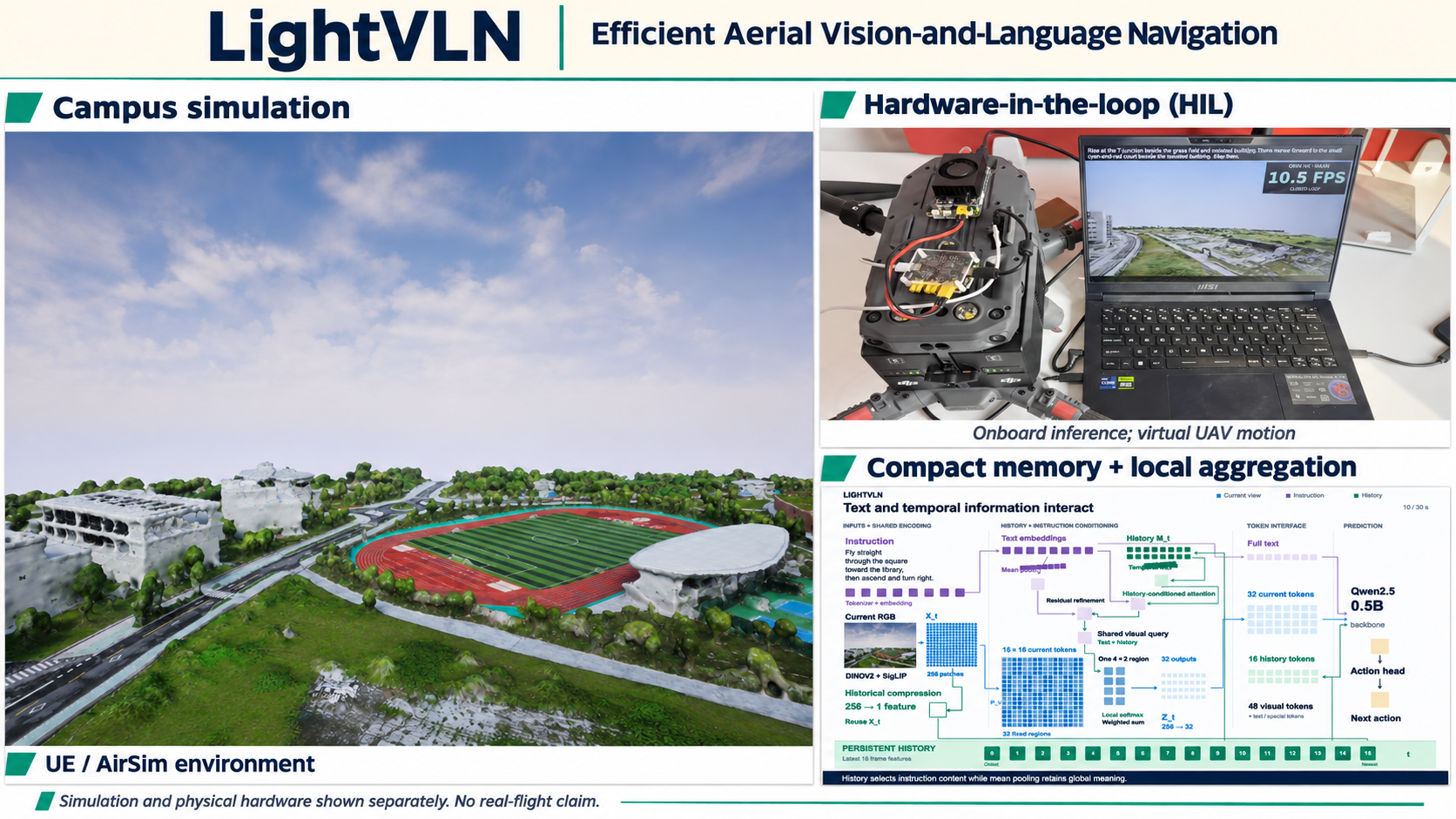
LightVLN is a lightweight aerial vision-and-language navigation framework that combines a compact language backbone, single-token historical memory, and history- and instruction-conditioned local aggregation to reduce inference costs while maintaining competitive navigation performance and enabling real-time closed-loop onboard-compute HIL evaluation on Jetson Orin NX. In this HIL setup, the onboard computer controls a virtual UAV in AirSim.
Publication status and available resources are shown for each project.
31 of 31 projects
Commit While Futures Agree
Preprint
First public: · Lab-led research
First author: Yuyan Li
An inference-time rule for action-chunking robot policies: continue a chunk while predicted futures agree and replan when they diverge. The paper reports reductions in failures in its simulation benchmarks and AgiBot G2 manipulation experiments.
LightVLN is a lightweight aerial vision-and-language navigation framework that combines a compact language backbone, single-token historical memory, and history- and instruction-conditioned local aggregation to reduce inference costs while maintaining competitive navigation performance and enabling real-time closed-loop onboard-compute HIL evaluation on Jetson Orin NX. In this HIL setup, the onboard computer controls a virtual UAV in AirSim.
EWR plans truck-assisted UAV delivery on an energy graph updated by wind estimates and payload state, continuously checking return feasibility. The paper evaluates it on synthetic delivery graphs with replayed wind logs.
Related manuscripts from the same research line; their revision or extension relationship remains unconfirmed.
Co-first authors: Zhewei Zhang · Puyue Wang · Guanren Qiao
Cross-layer conditioning for vision-language-action models: features from several depths of the vision-language backbone are routed into the action decoder as depth-aware information routing.
Axis-wise trajectory forecasts are refined with a diffusion model and connected to distributed predictive control. The paper studies prediction and closed-loop tracking for coordinated UAV motion under disturbances and modeling uncertainty.
A black-box adversarial attack on automatic speech recognition that searches self-supervised speech representations instead of raw waveforms, exposing a blind spot in current robustness evaluation.
PLAN-S decodes style-conditioned semantic cost maps from latent world models, making planning preferences inspectable before trajectory selection. The same bridge supports regression and anchor-score planners, evaluated on nuScenes and NAVSIM.
A structured visual-perturbation study examines how VLA driving decisions depend on camera input. Evaluations compare open-loop trajectory prediction with closed-loop driving behavior, revealing that visual grounding varies across perturbations and evaluation settings.
A unified feed-forward model for geometry perception. The project page shows reconstructions from campus scenes to driving sequences, results across seven tasks, and an available live demo.
MARS is a transfer-based black-box attack for evaluating SSL-based singing voice deepfake detectors. It replaces surrogate-boundary crossing with semantic and artifact anchors, and escapes the Linearity Trap through bi-level optimization that explores tangential detours before returning toward the natural semantic manifold.
Task offloading and resource scheduling for space-air-ground-sea networks that provide computing support for vessels. The paper reports at least a 23% reduction in average task delay against its simulation benchmarks.
The May 2026 preprint remains the primary paper. A related September manuscript is listed separately; its version relationship remains unconfirmed.
BER is an online risk-sensitive routing framework for truck-assisted UAV delivery on a time-dependent energy graph. The paper evaluates return-feasibility checks in synthetic delivery scenarios with quasi-real wind logs.
Related manuscripts from the same research line; their revision or extension relationship remains unconfirmed.
A hierarchical benchmark for building-facade inspection that evaluates multimodal models on semantic perception, spatial localization and generative segmentation. The released dataset and benchmark are intended for academic research.
Multi-camera 3D object detection that generalises to robots and vehicles with unseen camera configurations by addressing differences in intrinsics, extrinsics and array layout.
A public framework survey of object-centric world-action models for composable robot manipulation. It connects semantic, geometric and tactile state with skill composition, verification and recovery, illustrated through a small Meta-World diagnostic study and Isaac Sim simulation demonstrations.
Selecting sensor-equipped vehicles for urban sensing from accessible data while balancing coverage and redundancy. The paper reports an evaluation using data from 320 air-quality sensing vehicles in Guangzhou.
The ITSC 2025 paper remains the primary paper. The related TRC 2026 article is listed separately; their version relationship remains unconfirmed.
A systematic study shows that mainstream VLMs fail to plan correct trajectories in most work-zone scenes. REACT-Drive converts prior failure cases into constraint rules and executable planning code, and retrieves similar patterns with RAG to guide trajectory generation in new scenarios, evaluated on ROADWork and with a real vehicle.
Lane changes among human drivers of different styles: a dual-perspective cooperation score predicts how surrounding drivers will respond and guides decision-making and motion planning.
A multi-tier UAV edge-computing system pairs lightweight aerial servers with a higher-tier backup. The journal and conference versions evaluate delay and long-term energy stability through simulation.
First public: · Member first author / Cross-institution collaboration
First author: Yifan Liao
Diffusion-based data poisoning that places realistic backdoor triggers in lane-detection training data at heatmap-selected positions while preserving lanes and scene integrity.
Yifan Liao is first author; the formal CVPR paper lists HKUST(GZ) alongside partner institutions.
SkyVLN combines vision-and-language navigation with nonlinear model predictive control for instruction-following UAV navigation. The paper evaluates the system in simulated urban environments in AirSim.
Co-first authors (2025 preprint): Hongliang Lu · Shuqi Shen
A data-light inverse reinforcement learning framework adapts autonomous-driving behavior across driving cultures. The paper evaluates how local driving data can recalibrate the learned policy.
The 2025 preprint remains the primary paper. A related author-listed manuscript and its software are shown separately; the version relationship remains unconfirmed.
Multi-tier task offloading for vehicular edge computing over V2X that jointly optimises vehicle matching, communication and computing for sequential subtasks.
Co-first authors (arXiv v3): Hui Zhong · Hongliang Lu
High-resolution mapping of on-road air pollution using measurements from 314 sensor-equipped taxis. The paper examines fine-scale exposure patterns and the coverage provided by mobile sensing.
Depth completion that generalises to unseen scenes by replacing conventional normalisation layers with scale propagation normalisation (SP-Norm), with fast and efficient inference.
Co-first authors (preprint): Xianda Chen · Pak Hin Tiu
A car-following model that adapts to new traffic data while reducing forgetting through elastic weight consolidation and memory-aware synapses, evaluated on Waymo and Lyft data.
Zero-shot car-following prediction with large language models, recasting car following as language modelling over structured prompts for better accuracy and interpretability.
Deep reinforcement learning for car-following control in mixed traffic, treating consecutive human-driven vehicles as an aggregated unit between connected automated vehicles. The IEEE IV 2024 paper evaluates the controller using HighD driving data.